HELOCs 2026: Sub-8% Rates for Homeowners
Advertisements
With average HELOC rates hovering around 7.3%, homeowners have a prime opportunity to leverage their home equity below the 8.0% threshold. Here is a look at what has changed, key borrowing strategies, and what to monitor next.
Understanding HELOCs in a Shifting Rate Environment
The financial landscape for homeowners is continually evolving, with interest rates playing a pivotal role in borrowing decisions.
As we approach 2026, the prospect of securing Home Equity Lines of Credit with rates below 8.0% presents a significant opportunity for many.
This potential shift could redefine how homeowners leverage their property’s value for various financial needs.
Understanding the mechanics of HELOCs and the factors influencing their rates is crucial for informed decision-making in this environment.
Expert analysis suggests that a combination of economic indicators and Federal Reserve policies will dictate the precise trajectory of these rates.
Homeowners should stay abreast of these developments to capitalize on favorable borrowing conditions.
Market Outlook for HELOCs 2026 Rates Below 8.0%
Current projections from leading financial institutions indicate a cautious optimism regarding interest rate trends for Home Equity Lines of Credit.
While volatility remains a factor, the consensus points towards opportunities for rates to dip below the 8.0% threshold in 2026.
This outlook is largely influenced by anticipated adjustments in monetary policy and a potential stabilization of inflation.
For homeowners, this means a more attractive borrowing environment compared to recent years, making HELOCs a viable option for various financial goals.
Analysts at major banks, including JPMorgan Chase and Bank of America, have released reports suggesting that competitive pressures among lenders could also drive rates down.
This creates a favorable climate for those seeking Home Equity Lines of Credit (HELOCs) in 2026: Strategies for Utilizing Rates Below 8.0%.
Economic Factors Influencing HELOC Rates
Several key economic indicators are currently shaping the interest rate environment for HELOCs.
The Federal Funds Rate, set by the Federal Reserve, remains a primary driver, with any adjustments directly impacting variable HELOC rates.
Inflationary pressures, while easing, continue to be monitored closely, as persistent inflation could prompt the Fed to maintain higher rates.
Additionally, the overall health of the housing market and consumer confidence play significant roles in how lenders price their Home Equity Lines of Credit offerings.
Lender Competition and Rate Offerings
Increased competition among banks and credit unions is expected to lead to more aggressive HELOC rate offerings.
Lenders may introduce promotional rates or introductory offers to attract qualified borrowers.
Comparing offers from multiple financial institutions will be essential to secure the best possible rates below 8.0% for Home Equity Lines of Credit.
Eligibility and Qualification for Favorable HELOCs
Securing a Home Equity Line of Credit with advantageous rates, particularly below 8.0%, hinges on several crucial eligibility criteria.
Lenders meticulously assess a borrower’s financial health, creditworthiness, and the equity built up in their home.
A strong credit score, generally above 700, is often a prerequisite for the most competitive rates.
Additionally, a low debt-to-income ratio demonstrates a borrower’s capacity to manage additional credit, making them a more attractive candidate for lenders offering Home Equity Lines of Credit (HELOCs) in 2026: Strategies for Utilizing Rates Below 8.0%.
The amount of equity in the home is paramount; lenders typically require a loan-to-value (LTV) ratio of 80% or less.
This means homeowners should aim to have at least 20% equity in their property to qualify for optimal HELOC terms.

Credit Score and Financial Health
A robust credit history and high credit score are non-negotiable for accessing the best HELOC rates. Lenders use these metrics to gauge a borrower’s reliability and their likelihood of repaying the debt.
Maintaining a low debt-to-income ratio, ideally below 43%, is also vital.
This ratio indicates how much of a borrower’s gross monthly income goes towards debt payments, directly influencing their ability to handle new credit obligations from Home Equity Lines of Credit.
Home Equity and LTV Ratio
Lenders typically require a minimum of 20% equity in the home, translating to an 80% LTV ratio or lower.
A higher equity percentage can lead to more favorable HELOC terms and a larger line of credit.
Regular home appraisals will determine the current market value, which is critical for calculating available equity for Home Equity Lines of Credit.
Strategic Uses of HELOCs with Sub-8.0% Rates
The availability of Home Equity Lines of Credit with rates below 8.0% in 2026 opens up a range of strategic financial opportunities for homeowners.
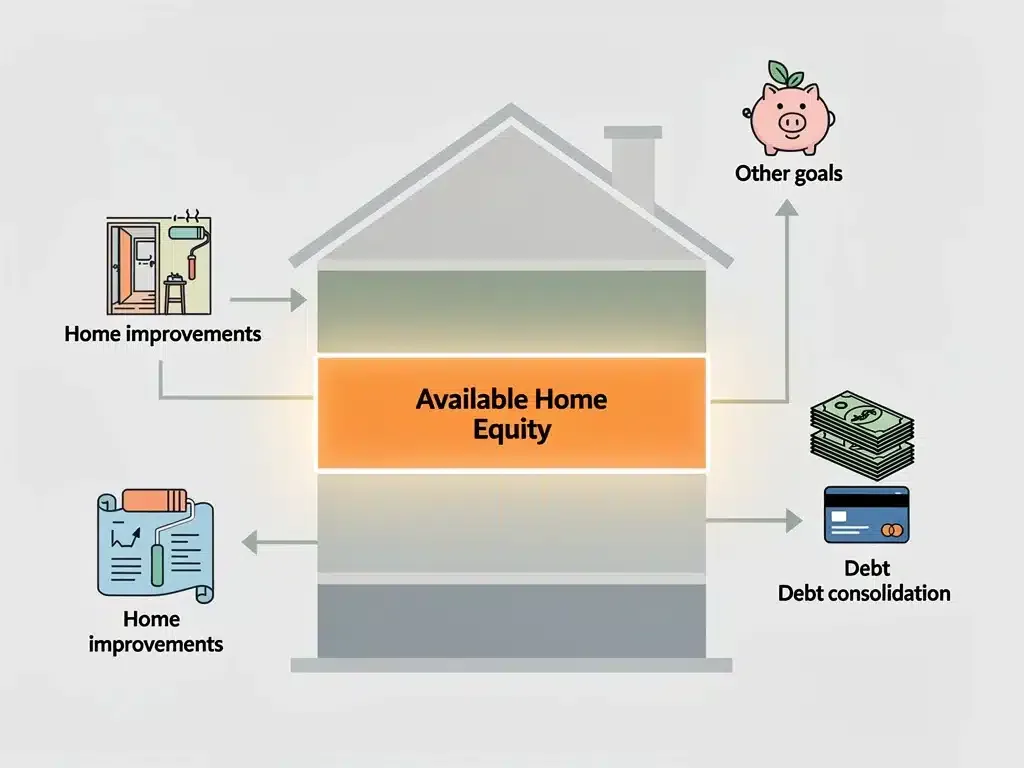
These favorable rates make HELOCs an attractive option for various purposes, from home improvement projects to debt consolidation.
Utilizing a HELOC for significant home renovations can increase property value, effectively making the borrowed funds an investment.
This approach is particularly beneficial when the interest rate is competitive, as it minimizes the cost of borrowing for future gains.
Another powerful application is debt consolidation, especially for high-interest debts like credit card balances.
By transferring these debts to a lower-interest HELOC, homeowners can significantly reduce their monthly payments and overall interest paid, improving their financial health.
Maximizing Value with Lower Interest HELOCs
When considering a Home Equity Line of Credit, it is essential to have a clear plan for how the funds will be used to maximize their value.
A well-thought-out strategy ensures that the borrowed capital serves its intended purpose without becoming an additional financial burden.
For instance, investing in energy-efficient home improvements not only increases property value but also reduces utility costs over time.
This dual benefit amplifies the financial advantage of securing a HELOC at a low interest rate, making Home Equity Lines of Credit (HELOCs) in 2026: Strategies for Utilizing Rates Below 8.0% a smart move.
Conversely, using a HELOC for discretionary spending without a clear return on investment can be risky.
The variable nature of HELOC rates means that while current rates may be below 8.0%, they can fluctuate, potentially increasing future payment obligations.
Home Improvement and Renovation Projects
Funding major home renovations like kitchen or bathroom remodels, which typically offer a good return on investment.
Undertaking energy-efficient upgrades such as solar panel installation or new windows to reduce long-term utility expenses.
Using the flexibility of a HELOC to manage project costs as they arise, rather than taking out a single lump-sum loan.
Debt Consolidation and Financial Management
Consolidating high-interest consumer debts, such as credit card balances or personal loans, into a lower-interest HELOC can lead to substantial savings.
This strategy simplifies debt management by combining multiple payments into one, often with a more favorable rate.
It is crucial to approach debt consolidation with discipline, avoiding the accumulation of new high-interest debt after using the HELOC.
The goal is to reduce overall debt burden and improve cash flow, making the most of Home Equity Lines of Credit (HELOCs) in 2026: Strategies for Utilizing Rates Below 8.0%.
Risks and Considerations for HELOC Borrowers
While the allure of Home Equity Lines of Credit with rates below 8.0% is strong, borrowers must carefully consider the inherent risks.
HELOCs are secured by your home, meaning failure to repay could result in foreclosure, a significant financial consequence.
The variable interest rate nature of most HELOCs introduces payment uncertainty. While rates may start low, they can increase over time, potentially leading to higher monthly payments than initially anticipated.
This risk necessitates careful budgeting and financial planning.
Understanding the draw period and repayment phase is also critical. During the draw period, borrowers can access funds, often with interest-only payments.
The repayment phase typically involves principal and interest, which can significantly increase monthly obligations, impacting strategies for Home Equity Lines of Credit (HELOCs) in 2026: Strategies for Utilizing Rates Below 8.0%.
Variable Interest Rate Volatility
The primary risk associated with HELOCs is the variability of their interest rates.
These rates are often tied to a benchmark index, such as the prime rate, which can fluctuate with economic conditions and Federal Reserve policy decisions.
Borrowers should model different interest rate scenarios to understand the potential impact on their monthly payments.
This proactive approach helps in preparing for possible increases and ensuring the HELOC remains manageable, even if rates climb above 8.0%.
Impact on Home Equity and Foreclosure Risk
A HELOC reduces the available equity in your home, which could be problematic if property values decline.
Failure to make timely payments on a HELOC can lead to default and, ultimately, foreclosure, as your home serves as collateral.
It is essential to borrow responsibly and ensure a clear repayment strategy to mitigate the risk of losing your home.
Comparing HELOCs with Other Financing Options
When considering how to access your home equity, it is crucial to compare Home Equity Lines of Credit with other available financing options.
Each product has distinct features that may better suit specific financial goals and risk tolerances.
Home equity loans, for example, offer a fixed interest rate and a lump-sum payout, providing predictable monthly payments.
This contrasts with the variable rates and revolving credit nature of HELOCs, making the choice dependent on individual needs.
Cash-out refinances also allow homeowners to tap into their equity, but they involve refinancing the entire mortgage.
Understanding the pros and cons of each option is vital for making an informed decision, especially when aiming for Home Equity Lines of Credit (HELOCs) in 2026: Strategies for Utilizing Rates Below 8.0%.
HELOC vs. Home Equity Loan
A key differentiator between a HELOC and a home equity loan lies in their structure. A home equity loan provides a fixed amount of money at a fixed interest rate, leading to consistent monthly payments throughout the loan term.
Conversely, a HELOC functions more like a credit card, allowing borrowers to draw funds as needed up to a certain limit, with interest only charged on the amount borrowed.
The interest rate is typically variable, which could be an advantage if rates fall, but a disadvantage if they rise, affecting Home Equity Lines of Credit (HELOCs) in 2026: Strategies for Utilizing Rates Below 8.0%.
Cash-Out Refinance Alternatives
A cash-out refinance replaces your existing mortgage with a new, larger one, allowing you to take the difference in cash.
This option can be beneficial if current mortgage rates are lower than your existing rate, but it involves closing costs and a new loan term.
Consider a cash-out refinance if you prefer a single, fixed-rate mortgage payment and need a large lump sum, rather than the flexibility of a HELOC.
Future Trends and Expert Forecasts for HELOCs
Looking beyond 2026, financial experts anticipate several trends that could further shape the landscape of Home Equity Lines of Credit.
Technological advancements and evolving consumer behaviors are expected to play a significant role in how these products are offered and utilized.
Digital platforms are likely to streamline the HELOC application process, making it faster and more accessible for homeowners.
Personalized rate offerings, based on advanced data analytics, could also become more prevalent, catering to individual borrower profiles.
Moreover, regulatory changes and increased emphasis on financial literacy will empower consumers to make more informed decisions regarding their home equity.
This forward-looking perspective is crucial for anyone considering Home Equity Lines of Credit (HELOCs) in 2026: Strategies for Utilizing Rates Below 8.0%.
Technological Innovations in Lending
The integration of artificial intelligence and machine learning in loan underwriting is set to revolutionize the HELOC application process.
These technologies can assess risk more efficiently, potentially leading to quicker approvals and more tailored product offerings.
Online portals and mobile applications will continue to enhance the borrower experience, providing real-time access to account information and facilitating seamless fund transfers.
This digital transformation will make Home Equity Lines of Credit more user-friendly and accessible.
Regulatory Landscape and Consumer Protection
Anticipated regulatory updates aim to enhance transparency and consumer protection in the HELOC market.
Increased focus on clear disclosures regarding variable rates and repayment terms will help borrowers make informed decisions.
Ongoing efforts to combat predatory lending practices will ensure a fairer borrowing environment for Home Equity Lines of Credit.
Key Point | Brief Description |
|---|---|
Rate Outlook | Optimism for HELOC rates below 8.0% in 2026 due to economic shifts. |
Eligibility Factors | Strong credit, low DTI, and significant home equity are crucial. |
Strategic Uses | Ideal for home improvements and high-interest debt consolidation. |
Key Risks | Variable rates and potential for home foreclosure are significant concerns. |
Frequently Asked Questions About HELOCs in 2026
What are the primary benefits of a HELOC with rates below 8.0%?▼
The main benefits include lower borrowing costs, making it more affordable to finance large expenses like home renovations or consolidate high-interest debt. The flexible access to funds, drawing only what’s needed, also optimizes interest payments.
How can I ensure I qualify for the best HELOC rates in 2026?▼
To secure optimal HELOC rates, maintain an excellent credit score, keep your debt-to-income ratio low, and ensure substantial equity in your home. Shopping around with multiple lenders is also critical to compare offers.
Are HELOC rates expected to remain below 8.0% throughout 2026?▼
While projections indicate opportunities for rates below 8.0%, HELOCs typically have variable rates tied to economic indices. These rates can fluctuate, so borrowers should prepare for potential increases, despite current favorable forecasts.
What is the difference between a HELOC and a home equity loan?▼
A HELOC offers a revolving line of credit with variable interest rates, allowing flexible borrowing as needed. A home equity loan provides a lump sum at a fixed interest rate, with consistent monthly payments over a set term.
What are the major risks associated with taking out a HELOC?▼
Key risks include variable interest rates that can increase monthly payments, and the fact that your home serves as collateral, meaning default could lead to foreclosure. Responsible borrowing and a clear repayment plan are essential.
What This Means
The current financial climate presents a unique window for homeowners to leverage their equity through Home Equity Lines of Credit (HELOCs) in 2026: Strategies for Utilizing Rates Below 8.0%.
This opportunity demands careful consideration of market forecasts, eligibility requirements, and strategic use of funds.
Comparing options and shopping around to prequalify for HELOC rates and lender offerings will be paramount for securing the most favorable terms.
As the market continues to evolve, proactive financial planning and a clear understanding of both benefits and risks will empower homeowners to make sound decisions that enhance their financial well-being.