Demystifying Private Student Loans in 2026: Lenders & Terms
Advertisements
Borrowers evaluating private student loan options for the 2026 academic year face a dynamic credit environment characterized by variable interest rate structures, strict underwriting requirements, and evolving co-signer release policies.
Families are encouraged to exhaust federal student aid options first before using private financing to bridge remaining college funding gaps.
Understanding the Landscape of Private Student Loans in 2026
The academic year 2026 is rapidly approaching, and with it, students and families are once again confronting the complex world of higher education financing. While federal student loans remain a cornerstone, private student loans 2026 are playing an increasingly significant role for many.
These private options, offered by banks, credit unions, and online lenders, often bridge the gap between federal aid and the total cost of attendance. Understanding their nuances, from interest rates to repayment flexibility, is critical for making sound financial decisions.
This report delves into the projected environment for private student loans in 2026, offering an educational comparison of top lenders and their anticipated terms. Our aim is to provide clarity amidst the often-daunting array of choices.
Key Trends Shaping Private Student Loans in 2026
Several economic and regulatory factors are expected to influence the private student loan market in 2026. Interest rate fluctuations, driven by broader economic policy, will undoubtedly be a primary concern for borrowers seeking favorable terms.
Additionally, evolving consumer protection regulations and lender competition will likely shape product offerings and eligibility criteria. Staying informed about these overarching trends is essential for anyone considering private student loans 2026.
Technological advancements are also streamlining the application and approval processes, making private student loans 2026 more accessible but also requiring borrowers to be more vigilant in comparing digital platforms. The shift towards online-first lending continues to gain momentum.
Anticipated Interest Rate Environment
The Federal Reserve’s monetary policy will significantly dictate the variable interest rates associated with private student loans in 2026. Borrowers should expect rates to reflect the general economic climate, with potential for both upward and downward shifts.
Fixed-rate options, while offering stability, may come at a slightly higher initial cost but provide predictability over the loan’s lifetime. A thorough analysis of current economic forecasts is prudent before committing to either rate type for private student loans 2026.
Regulatory Shifts and Consumer Protection
The landscape of consumer protection for private student loans 2026 is constantly under review, with potential legislative changes aiming to enhance borrower rights or streamline dispute resolution. These changes could impact everything from disclosure requirements to collection practices.
Lenders are also adapting to these shifts, often pre-emptively updating their terms and conditions to ensure compliance. Borrowers should meticulously review all loan documents for any new provisions related to their private student loans 2026.
Potential for increased transparency in loan disclosures.
Focus on clearer communication regarding repayment options.
Enhanced mechanisms for addressing borrower complaints.
Top Private Student Loan Lenders for 2026: An Overview
As we look towards 2026, several prominent lenders are expected to continue dominating the private student loan market. These institutions differentiate themselves through various offerings, including competitive interest rates, flexible repayment plans, and unique borrower benefits.
Each lender caters to a slightly different demographic or financial situation, making a one-size-fits-all recommendation impossible. A detailed comparison is paramount for those exploring private student loans 2026.
Understanding the strengths and weaknesses of each major player will empower students and their families to select the most suitable option for their specific needs when considering private student loans 2026.
Sallie Mae: A Long-Standing Player
Sallie Mae remains a significant entity in the private student loan sector, known for offering a wide array of loan products tailored for undergraduate, graduate, and professional studies. Their terms typically include both fixed and variable interest rates, along with multiple in-school and post-graduation repayment options.
They often provide benefits such as interest rate reductions for automatic payments and a multi-year advantage for eligible borrowers. For many, Sallie Mae is a default consideration when researching private student loans 2026.
Discover Student Loans: Simplicity and Rewards
Discover Student Loans has carved out a niche with its straightforward loan products and often-cited cash reward for good academic performance. They offer competitive rates and a transparent application process, appealing to students seeking simplicity.
Their customer service is frequently highlighted as a strong point, providing accessible support throughout the loan lifecycle. This makes Discover an attractive option for private student loans 2026 for those prioritizing ease of use and potential academic perks.
Cash rewards for good grades.
No application or origination fees.
Dedicated U.S.-based loan specialists.
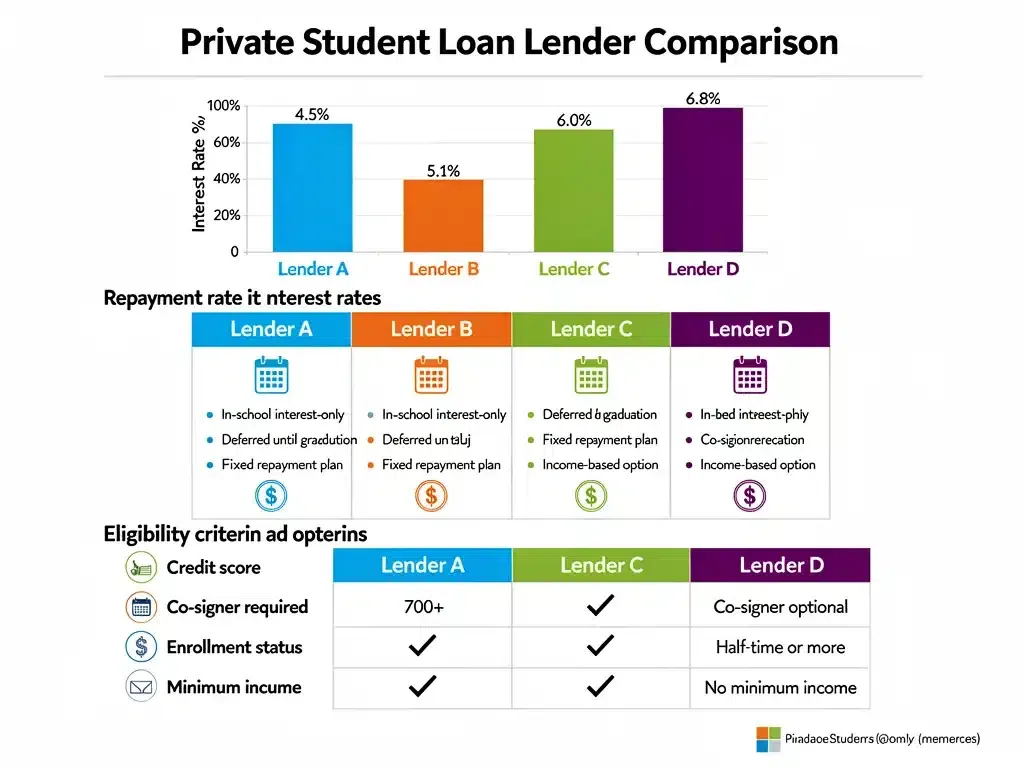
Comparing Loan Terms: Interest Rates and Repayment Options
The core of any private student loan comparison lies in its terms, particularly interest rates and repayment flexibility. These two factors will have the most significant impact on the total cost of the loan and the borrower’s financial burden post-graduation.
Variable rates can be lower initially but carry the risk of increasing over time, while fixed rates offer stability but might start higher. The choice between them for private student loans 2026 depends heavily on individual risk tolerance and economic outlook.
Repayment options vary widely, from immediate full payments to deferred payments until after graduation, and even options for interest-only payments during schooling. Understanding these distinctions is crucial for managing private student loans 2026 effectively.
<br>
Understanding Fixed vs. Variable Interest Rates
Fixed interest rates remain constant throughout the life of the loan, providing predictable monthly payments. This stability is often preferred by borrowers who value certainty and want to avoid potential increases in their financial obligations.
Variable interest rates, conversely, can fluctuate based on market indices like the SOFR (Secured Overnight Financing Rate), potentially leading to lower initial payments but also the risk of higher payments later. The decision between these for private student loans 2026 requires careful consideration of future economic projections.
Exploring Repayment Plans and Flexibility
Most lenders offer various repayment plans, including deferred payment, interest-only payments, and immediate full principal and interest payments. Deferred payment plans allow students to postpone payments until after graduation or leaving school, which can be beneficial during studies.
Interest-only plans require payments on accrued interest while in school, reducing the principal balance upon graduation. Fully understanding these options is vital when securing private student loans 2026, as they directly impact immediate and future financial strain.
Deferred repayment: No payments while in school and during grace period.
Interest-only repayment: Pay only interest while in school.
Immediate repayment: Begin paying principal and interest immediately.
Eligibility Criteria and Application Process for Private Student Loans 2026
Qualifying for private student loans in 2026 involves meeting specific eligibility criteria, which typically include creditworthiness, income stability, and often, the presence of a co-signer. Lenders assess these factors to determine the borrower’s ability to repay the loan.
The application process itself has become largely digital, offering a streamlined experience from initial inquiry to final disbursement. However, thoroughness and accuracy in providing financial information remain paramount.
Understanding what lenders look for and preparing the necessary documentation can significantly smooth the path to securing private student loans 2026. Early preparation is always advisable.
Creditworthiness and Co-Signer Requirements
Unlike federal loans, private student loans 2026 are primarily credit-based. Lenders will examine the borrower’s (and co-signer’s, if applicable) credit score and history to gauge their financial responsibility. A strong credit profile often leads to better interest rates and terms.
Many undergraduate students lack sufficient credit history, making a creditworthy co-signer almost a necessity for securing favorable private student loans 2026. The co-signer assumes equal responsibility for the loan.
Navigating the Online Application Process
The application for private student loans 2026 is typically completed online, requiring personal information, financial details, and school enrollment verification. The process usually involves a credit check, which may temporarily affect credit scores.
It is advisable to compare offers from multiple lenders without completing full applications to avoid multiple hard credit inquiries. Many lenders offer pre-qualification tools that provide estimated rates without impacting credit, a useful first step for private student loans 2026.

The Role of Co-Signers in Private Student Loans 2026
For many students, particularly those without an established credit history or sufficient income, a co-signer is a crucial component of securing private student loans 2026. A co-signer, typically a parent or guardian, agrees to be equally responsible for the loan.
This arrangement significantly increases the likelihood of approval and often results in more favorable interest rates due to the co-signer’s stronger credit profile. However, it also carries substantial responsibility for the co-signer.
Both the primary borrower and the co-signer should fully understand the implications before entering into such an agreement for private student loans 2026. Open communication about repayment expectations is vital.
Benefits and Responsibilities of a Co-Signer
The primary benefit of a co-signer is the improved chance of loan approval and access to better interest rates, which can save thousands over the life of the loan. Lenders view a co-signed loan as less risky, reflecting positively on the terms offered for private student loans 2026.
However, the co-signer is legally obligated to repay the loan if the primary borrower defaults, impacting their own credit. This shared responsibility makes it imperative for co-signers to be fully aware of the commitment involved with private student loans 2026.
Co-Signer Release Options
Some lenders offer a co-signer release option, allowing the co-signer to be removed from the loan after the primary borrower meets specific repayment criteria, such as a certain number of on-time payments and demonstrating financial stability. This feature can be a significant advantage.
Terms for co-signer release vary widely among lenders, so it’s essential to inquire about this possibility when comparing private student loans 2026. It provides a pathway for co-signers to eventually alleviate their financial obligation.
Specific number of consecutive on-time payments required.
Borrower must meet credit and income requirements independently.
Application process for co-signer release may be required.
Avoiding Common Pitfalls with Private Student Loans 2026
While private student loans 2026 can be an invaluable financial tool, they also come with potential pitfalls that borrowers should actively seek to avoid. These often stem from a lack of understanding of loan terms, over-borrowing, or neglecting to explore all available financial aid options first.
Failing to compare multiple lenders can result in higher interest rates and less favorable terms than necessary. Diligence in research and decision-making is key to a positive borrowing experience.
Being aware of these common mistakes and taking proactive steps to mitigate them will ensure a smoother and more affordable journey when dealing with private student loans 2026.
Over-borrowing and Debt Management
One of the most significant pitfalls is borrowing more than is absolutely necessary, which can lead to excessive debt post-graduation. Students should meticulously calculate their educational expenses and only borrow what is essential, factoring in all other forms of aid.
Developing a realistic budget and understanding future earning potential can help prevent over-borrowing with private student loans 2026. Responsible debt management starts even before the funds are disbursed.
The Importance of Comparing Lenders
Settling for the first loan offer without comparing terms from multiple lenders is a common and costly mistake. Interest rates, fees, and repayment flexibility can vary significantly, impacting the overall cost of private student loans 2026.
Using online comparison tools and obtaining pre-qualification offers from several institutions allows borrowers to find the most competitive rates and favorable terms. This due diligence is critical for smart borrowing decisions.
Key Aspect | Brief Description |
|---|---|
Interest Rates | Fixed vs. variable rates, influenced by economic trends for private student loans 2026. |
Repayment Options | Deferred, interest-only, or immediate payment plans available. |
Eligibility | Credit score, income, and co-signer requirements for private student loans 2026. |
Co-Signer Role | Increases approval chances, often required for better terms, shared responsibility. |
Frequently Asked Questions About Private Student Loans 2026
What are the primary differences between federal and private student loans in 2026?▼
Federal student loans are typically need-based, offer fixed interest rates, and provide more borrower protections like income-driven repayment. Private student loans 2026 are credit-based, offered by private institutions, and their terms vary widely. They generally have fewer borrower protections but can offer competitive rates for those with excellent credit or a co-signer.
How can I get the best interest rates for private student loans 2026?▼
To secure the best rates for private student loans 2026, focus on improving your credit score, consider a creditworthy co-signer, and compare offers from multiple lenders. A strong credit profile and a robust co-signer are key factors that lenders consider when determining interest rates and terms.
Is a co-signer always necessary for private student loans 2026?▼
While not always strictly necessary, a co-signer significantly increases the chances of approval and often leads to more favorable terms for private student loans 2026, especially for students without a substantial credit history or income. Many lenders prefer or require a co-signer for undergraduate loans.
What repayment options should I look for with private student loans 2026?▼
Look for flexible repayment options such as deferred payment (postponing payments until after graduation), interest-only payments while in school, or immediate full principal and interest payments. The best option depends on your current financial situation and future income projections after securing private student loans 2026.
What are the common fees associated with private student loans 2026?▼
Most reputable private student loans 2026 do not charge application or origination fees. However, be aware of potential late payment fees or returned payment fees. Always read the fine print of your loan agreement carefully to understand all associated costs before finalizing your borrowing decision.
Looking Ahead: Strategic Planning for Private Student Loans 2026
The landscape for private student loans 2026 demands strategic planning and informed decision-making. As economic conditions and regulatory frameworks continue to evolve, staying updated on lender offerings and market trends will be crucial.
Students and families should prioritize comprehensive research and personalized comparisons to navigate their options effectively. Proactive engagement with financial planning resources will yield the most beneficial outcomes when securing private student loans 2026.
For additional institutional guidance and regulatory insights on supplemental borrowing, examine the NASFAA Brief on Private Education Loan Planning.